What is crypto sharding?
Learn about crypto sharding, a method to enhance blockchain scalability and efficiency. Explore its impact on transaction speed and network performance.

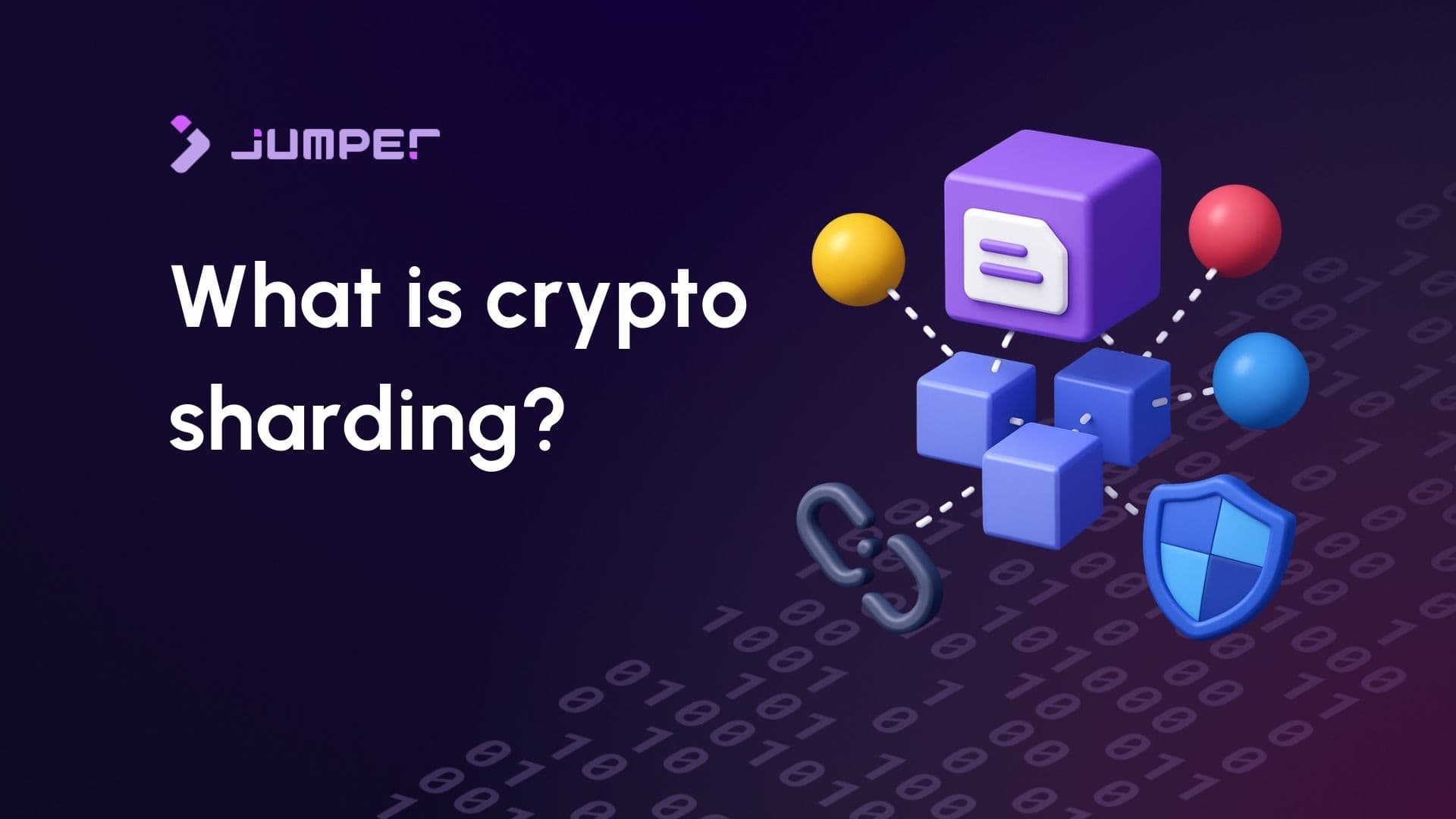
Crypto sharding is a blockchain scaling technique that partitions the network into smaller segments, called shards, each handling its own data and transactions. By splitting the workload, sharding boosts transaction throughput and reduces latency, much like how databases use horizontal partitioning to manage large datasets (see Investopedia’s explanation)[https://www.investopedia.com/terms/s/sharding.asp]. For DeFi users needing fast cross-chain swaps or liquidity across multiple shards and chains,
Jumper Exchangeaggregates liquidity sources and routes, enabling seamless transfers without juggling multiple bridges or DEXes.
Blockchains like Ethereum have struggled with limited transactions per second (TPS) and high gas fees as demand grows. Sharding offers a path forward by allowing parallel processing: each shard validates a subset of transactions rather than forcing every node to process every transaction. To explore how sharding can complement cross-chain DeFi strategies—such as moving tokens into sharded networks or balancing liquidity—check out the step-by-step tutorials on the
Jumper Learn huband monitor your cross-shard flows with the
Jumper Scan dashboard.Why do blockchains need sharding?
As blockchain adoption rises, networks face bottlenecks. Bitcoin processes around 7 TPS, and Ethereum averages 15–30 TPS, far below traditional payment systems like Visa (up to 65,000 TPS). This limited throughput leads to:
- Network Congestion: High transaction volumes cause long confirmation times.
- Rising Fees: Users pay more in gas to prioritize their transactions.
- User Friction: Slow speeds and unpredictable costs deter everyday use.
Sharding splits the network into multiple groups of nodes, each called a shard. Instead of every node processing every transaction, each shard handles a portion of transactions, increasing overall throughput. For DeFi traders, faster settlement means less slippage on swaps—something platforms like
Jumper Exchangeoptimize by aggregating liquidity across chains and, by extension, across shards when supported.
How sharding works
- Sharding partitions a blockchain’s data storage and transaction processing into independent segments. Key components include:
- Data Sharding: Each shard stores only a fraction of the blockchain’s state, reducing per-node storage requirements.
- Transaction Sharding: Transactions are assigned to shards based on sender or contract address, enabling parallel processing.
- Network Sharding: Network traffic and block propagation are split, so nodes only forward shard-specific data.
Shard Formation and Assignment
- Validator Assignment: Validators are randomly assigned to shards each epoch, reducing the risk of a malicious majority in one shard.
- Committee Rotation: Periodic reshuffling ensures security by preventing long-term control of any single shard.
- Beacon Chain Coordination: A central chain (like Ethereum 2.0’s Beacon Chain) coordinates shards, finalizes cross-shard state, and manages validator sets.
For users bridging tokens into sharded networks, tools like
Jumper Exchangecan automate the routing through the beacon chain and into specific shards, ensuring tokens reach their target shard without manual intervention.
Sharding versus other scaling solutions
Layer-2 Rollups
- Optimistic Rollups: Batch transactions off-chain and post summaries on-chain, assuming validity.
- ZK Rollups: Use zero-knowledge proofs to verify transactions before posting, offering faster finality.
Rollups reduce on-chain load but still require every node to process proofs or data on the main chain. Sharding tackles scalability at the base layer, enabling both on-chain and Layer-2 solutions to coexist.
Sidechains and State Channels
- Sidechains: Independent blockchains with federated bridges; can diverge in security and consensus.
- State Channels: Private channels for off-chain transactions between parties, with only final settlement on-chain.
Unlike sidechains, shards share a unified security model under the Beacon Chain or main consensus. State channels excel at high-frequency micropayments but don’t solve network-wide congestion.
Implementations of sharding in blockchain
Ethereum 2.0 (Eth2)
Ethereum’s roadmap splits into phases:
- Phase 0 (Beacon Chain): Launched in December 2020, introduced staking and validator management.
- Phase 1 (Shard Chains): Planned to spin up 64 shards that handle data and transactions.
- Phase 1.5 (Docking): Merge of Ethereum mainnet into Eth2, bringing execution and consensus layers together.
- Phase 2+ (Execution and Cross-Shard): Full smart contract support on shards and seamless cross-shard communication.
As shards come online, users will interact through shard-specific RPC endpoints. Cross-shard DeFi strategies—like moving assets between shards for yield farming—will benefit from automated routers.
Jumper Exchangeaims to support these multi-shard operations by extending its cross-chain aggregation to sharded environments in the future.
Zilliqa
Zilliqa launched in 2019 as the first public sharded blockchain. It began with:
- Network Shards: Each capable of processing 600 TPS.
- Directory Service Committee: A group of nodes that assigns new nodes to shards.
- Secure Randomness Generation: Ensures fair shard assignment.
Zilliqa’s design processes transactions in parallel across shards and then merges results. While Zilliqa focuses on simple smart contracts and high throughput, Ethereum’s shards aim for full EVM compatibility and broad DeFi support.
Cross-shard communication and consensus
Shards must interact to maintain a unified state. Key mechanisms include:
- Cross-Shard Messaging: Forwarding messages or transactions between shards, often batched and committed periodically.
- Atomic Transactions: Ensuring operations across multiple shards either complete fully or revert, avoiding partial updates.
- Finality and Checkpoints: The Beacon Chain or main consensus layer periodically anchors shard states, preventing forks.
Developers building cross-shard dApps can face complexity in ensuring consistent state. As a parallel, DeFi users navigating multiple chains and layer-2s rely on cross-chain aggregators.
Jumper Exchange’ssmart routing logic and unified interface prefigure how cross-shard tooling might evolve: one click swaps, bridges, and monitors transfers across segmented networks.
Benefits of crypto sharding
Increased Transaction Throughput
By processing transactions in parallel, sharding can raise network TPS from tens to thousands, enabling mass adoption and enterprise use cases.
Reduced Node Requirements
Nodes only store and validate their shard’s data, lowering hardware and bandwidth demands, encouraging decentralization by making it easier to participate as a validator.
Lower Transaction Costs
Less congestion and smaller per-block data mean lower gas fees. Users and dApps benefit from predictable, affordable costs—crucial for microtransactions and gaming.
Enhanced Scalability
Sharding scales horizontally: adding more shards increases capacity. Future upgrades can spin up additional shards as demand grows.
Challenges and drawbacks of sharding
Security Risks
- Cross-Shard Attacks: Malicious actors targeting specific shards with collusion could undermine security.
- Data Availability: If a shard’s data isn’t widely propagated, other shards may not validate cross-shard proofs properly.
Complexity in Development
Writing cross-shard smart contracts and ensuring atomicity demands new tooling and patterns. Developers need frameworks to manage state across shards.
Coordination Overhead
The Beacon Chain or equivalent coordinator bears significant load to manage validator rotations, finality, and cross-shard synchronization.
Delayed Rollout
Sharding is a major protocol upgrade requiring rigorous testing. Ethereum’s multi-year Eth2 rollout underscores the time and effort needed.
Database sharding analogy
In traditional databases, sharding refers to horizontal partitioning: distributing rows of a table across multiple database servers, each handling a subset of the data. Benefits include:
- Load Distribution: Queries and writes split across servers.
- Fault Isolation: A failure in one shard doesn’t crash the entire database.
- Scalable Growth: Adding more servers increases capacity.
Crypto sharding applies these principles to blockchain, but adds complexity: each node must agree on the global state while only storing partial data. Understanding database sharding helps developers grasp blockchain sharding concepts and design efficient dApps.
Practical tips for DeFi users preparing for sharded networks
- Stay Informed: Follow protocol upgrade schedules on official blogs and community forums.
- Test on Testnets: Before mainnet shards go live, practice cross-shard swaps on testnets using simulators.
- Manage Multiple RPC Endpoints: Use multi-RPC wallets to access each shard.
- Use Aggregation Tools: Platforms like Jumper Exchange illustrate the value of automated routing. As sharded networks emerge, look for upgraded bridges that handle shard-specific routing transparently.
- Monitor Shard Health: Early shards may face downtime or reorgs. Tools analogous to Jumper Scan dashboard for cross-chain flows will be critical for cross-shard visibility.
Simplifying cross-shard asset transfers with Jumper Exchange
In the same way you might need to move assets between Ethereum, BSC, and Polygon, sharded blockchains will require moving tokens between individual shards and the Beacon Chain.
Jumper Exchangeaggregates bridges and DEX routes into a single transaction. You choose your starting asset—like ETH or USDC—and your target environment, whether a shard or main chain, and Jumper’s smart routing engine automatically finds the best path. This reduces slippage, approval steps, and manual bridge interactions. The integrated
Scan dashboardprovides real-time tracking of your cross-shard transfers, so you know exactly when assets are available on each shard.
For developers and traders new to sharded networks, the
Learn huboffers clear tutorials on setting up RPC endpoints, configuring slippage tolerance, and automating cross-shard DCA strategies. Their detailed
guidedemystifies complex multi-step transfers—bridging liquidity into shards, swapping, and verifying settlements—so you can focus on building and trading rather than technical hurdles.
Charting the future of blockchain scalability
Crypto sharding represents a foundational solution for on-chain scalability, promising to unlock thousands of TPS, lower costs, and broader participation. As blockchains like Ethereum, Zilliqa, and future networks roll out sharding, developers and users must adapt to new paradigms of cross-shard architecture and tooling. By drawing lessons from database partitioning and leveraging automated aggregation platforms, the ecosystem can transition smoothly into a highly scalable, multi-shard world. The combined power of sharding at the protocol layer and cross-chain routers like
Jumper Exchangeat the application layer sets the stage for the next era of DeFi, gaming, and real-world asset tokenization.
Relevant Links
- Ethereum 2.0 Sharding Docs
- Zilliqa Official Site
- Jumper Exchange
- Jumper Scan Dashboard
- Jumper Learn Hub
- Jumper Step-by-Step Guide
- Cosmos IBC Documentation