How to Bridge to Plume and Explore the Ecosystem
A detailed overview of the Plume DeFi ecosystem.

Plume has quickly established itself as a leading RWA-focused chain. An RWA-first design, steady stablecoin yields, fast and cheap transactions, and active ecosystem incentives have made Plume a go-to destination for DeFi users who want onchain access to real-world yield.
The Plume ecosystem is growing fast, with new opportunities launching weekly. In this guide, we’ll explain what Plume is, how to bridge to Plume with Jumper, and which protocols are worth exploring first.
What is Plume?
is a new EVM-compatible blockchain purpose-built for Real World Assets. Unlike general-purpose chains, Plume integrates asset tokenization and compliance at the protocol level. The result is a chain where tokenized real-world assets behave just like any other token in DeFi – you can lend them, trade them, provide liquidity with them, and use them as collateral seamlessly. Plume bridges the gap between traditional finance and crypto by making real assets (like private credit, ETFs, commodities) accessible onchain.
Plume’s compliance-first rails appeal to institutions, while its open EVM environment stays friendly to retail and DeFi natives. In practice, this means regulated issuers and everyday onchain users meet in the same liquidity pools. Early deployments from projects like Morpho, Nest, Rooster, and even Curve Finance, plus issuers such as Midas and asset managers like YieldFi, have given Plume a full DeFi stack from day one. With incentive programs and new protocols rolling out, the chain is quickly becoming a hub for straightforward real-yield strategies.
Plume’s Growth
Since its Genesis launch in mid-2025, Plume has built real momentum. Total Value Locked (TVL) on the chain recently crossed $270M and continues to trend upward. This growth is supported by deep pUSD liquidity, plentiful yield opportunities, and low fees that make moving and deploying capital simple for everyday DeFi users.
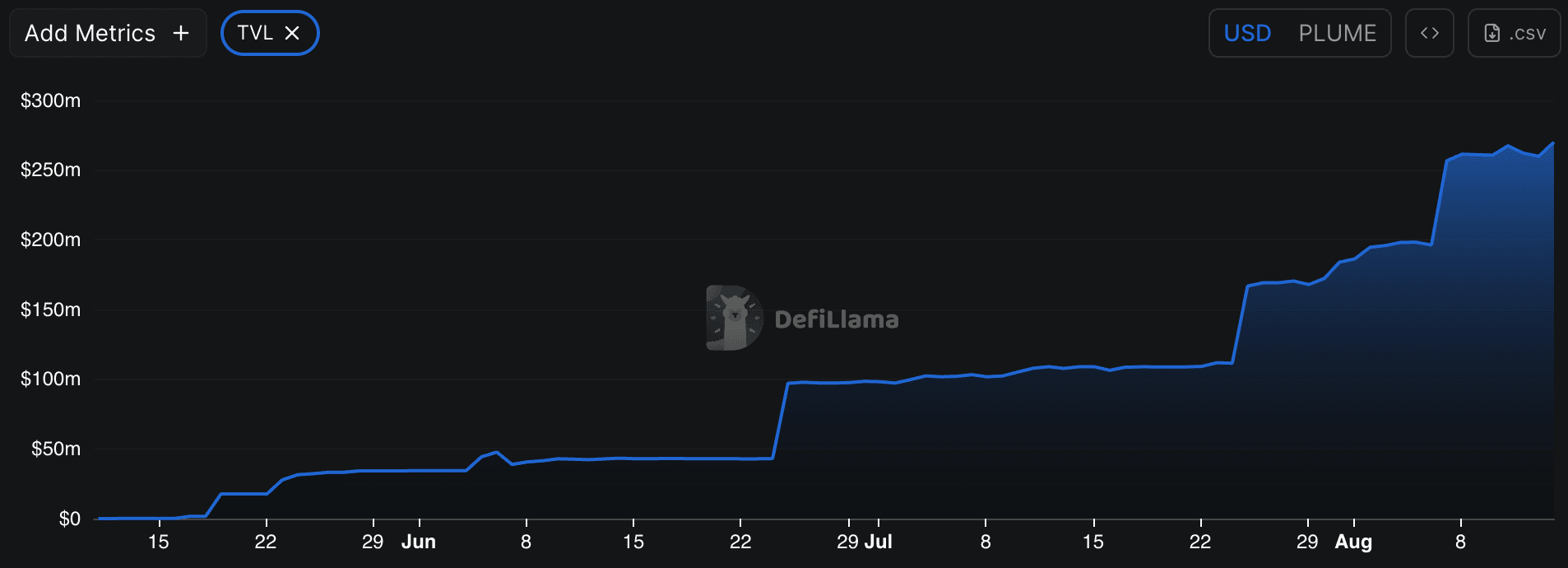
Plume TVL: steady climb. Source:
DeFiLlamaWhat’s pulling users in? Predictable and accessible real-yield on stablecoins combined with the ability to plug into high-quality onchain strategies with minimal overhead. Plume Points add extra upside for active users, but the core appeal is easy to access yield across the ecosystem.
So, how do you get in on it? First, you’ll need to bridge funds to Plume using Jumper Exchange. We’ll walk you through the steps next.
How to bridge to Plume?
Before you can explore the Plume ecosystem, you need some funds on Plume. Jumper Exchange is the perfect way to bridge your assets to Plume. Jumper enables you to bridge any asset from any of the supported chains to any asset on Plume.
Here’s how to get started:
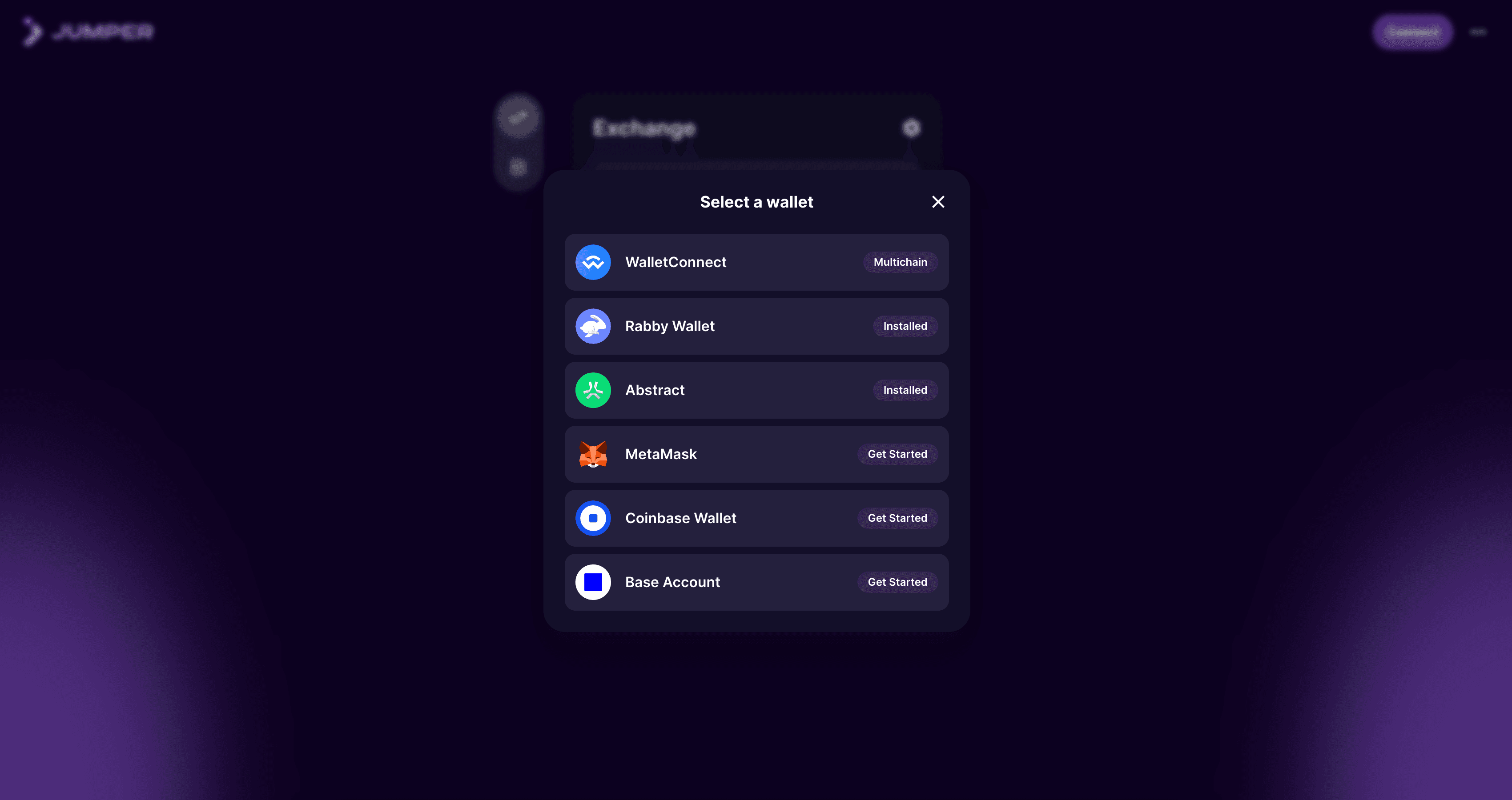
1. Connect Your Wallet
Open Jumper Exchange and connect your wallet.
2. Select Your Route
Choose the source-chain and asset from which you want to bridge to Plume. Jumper will automatically figure out the most optimal route for you.
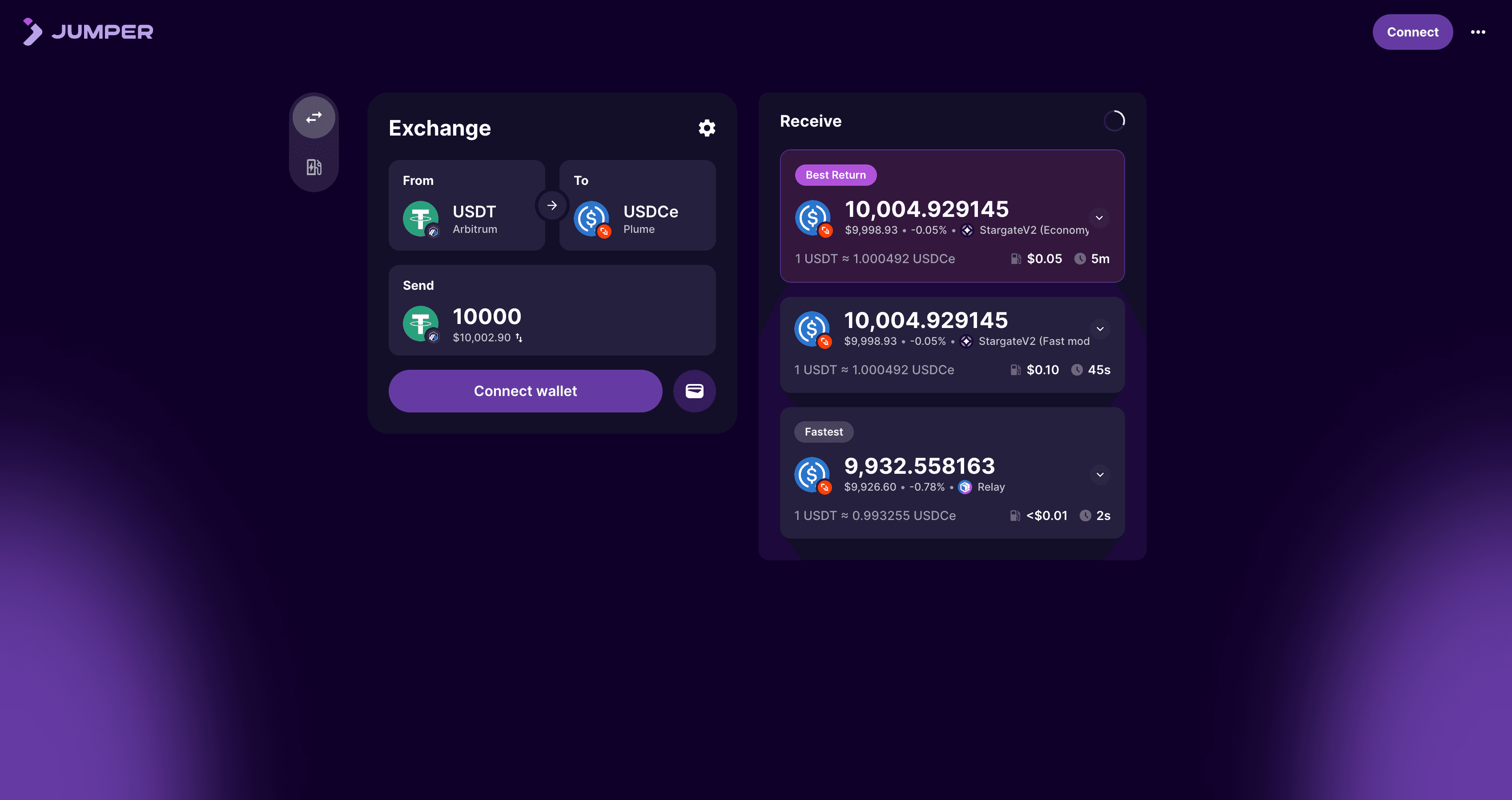
Jumper currently supports transactions to Plume from most EVM chains, including Ethereum, Optimism, Arbitrum, Unichain, HyperEVM, Berachain, and Base, as well as Solana. More chains are coming soon.
3. Confirm and Bridge
Double-check the details (source, destination, amounts) and then confirm the transaction in your wallet. Jumper will handle the rest and your assets will be bridged to Plume in no time.
Now that your funds are on Plume, you’re ready to explore the ecosystem! Let’s check out some of Plumes’s most popular protocols and what they offer.
Exploring the Plume Ecosystem
To kick off your journey, head to the
Plume Portal– the chain’s all-in-one discovery hub for verified dApps, onchain quests, RWA prizes, and other featured opportunities. In the Portal you can browse DeFi apps, find yield strategies, see your earnings in real time, and track your Plume Points all in one place. Below, we highlight a few key protocols in Plume’s ecosystem and why you might want to try them first:
Nest
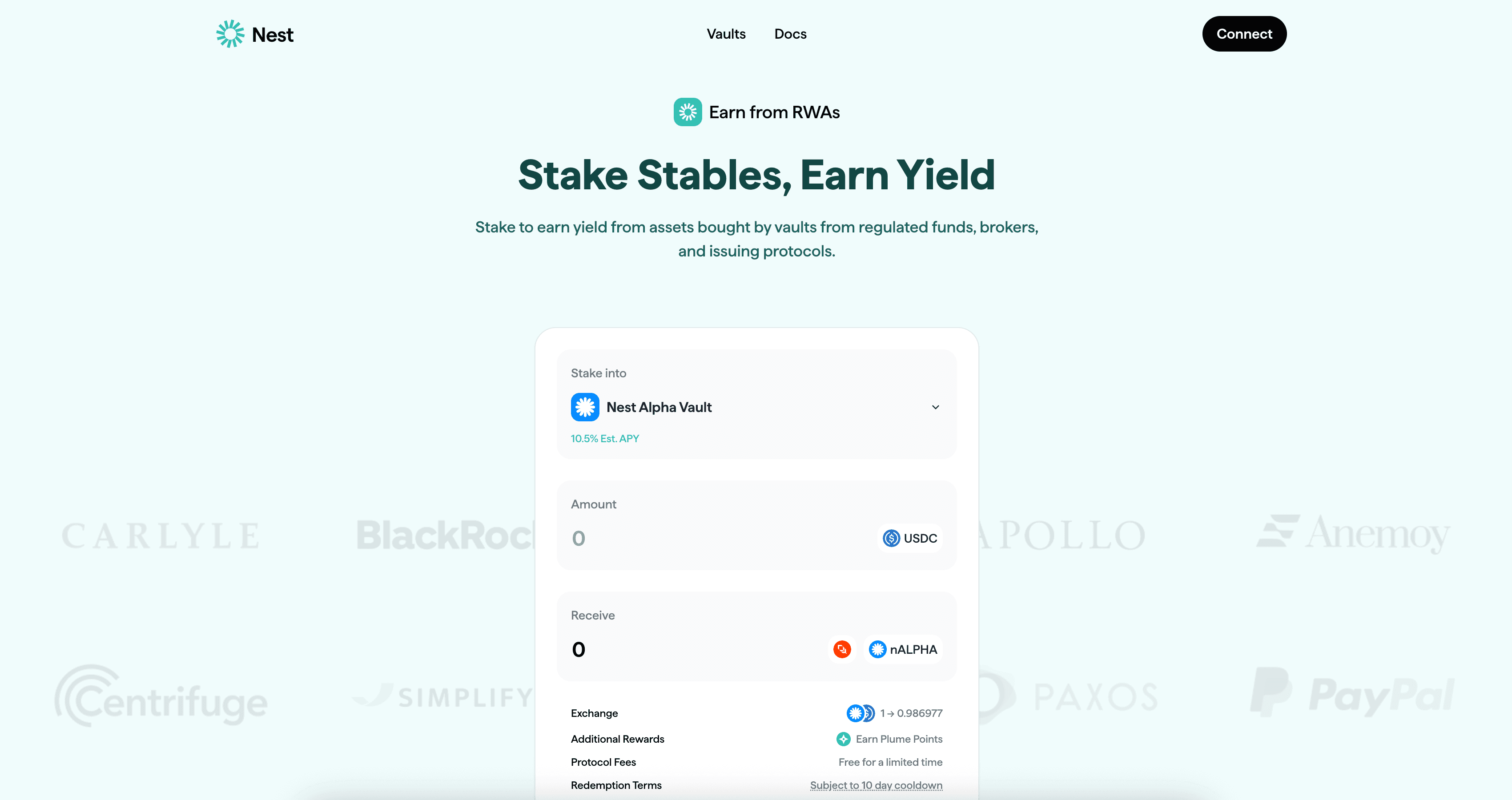
is Plume’s flagship RWA yield platform. In Nest, users deposit pUSD into curated vaults and receive nTokens (e.g. nALPHA, nCREDIT, nBASIS) in return. These nTokens continuously accrue yield from diversified real-world asset exposure, such as treasuries, private credit, or ETFs.
Nest’s vaults are curated and compliance-aware. The underlying assets are sourced from regulated entities and undergo rigorous due diligence. The vaults themselves are fully onchain and non-custodial, meaning Nest never actually holds cash or offchain assets on users' behalf, it simply tokenizes and tracks them.
By the numbers:
Nest currently holds an impressive $77M in TVL (according to DeFiLlama)
When you deposit into a Nest vault, your nToken automatically accrues yield sourced from the vault’s underlying RWAs (e.g. basis trades, credit, ETF exposure). nTokens are composable, which means you can also deploy them across Plume for some more complex strategies. More on this later.
Current Yields:
- Nest Basis Vault: ~9% APY
- Nest Alpha Vault: ~9% APY
- Nest Institutional Vault: ~10% APY
Interacting with Nest qualifies users for Plume Points.
Morpho
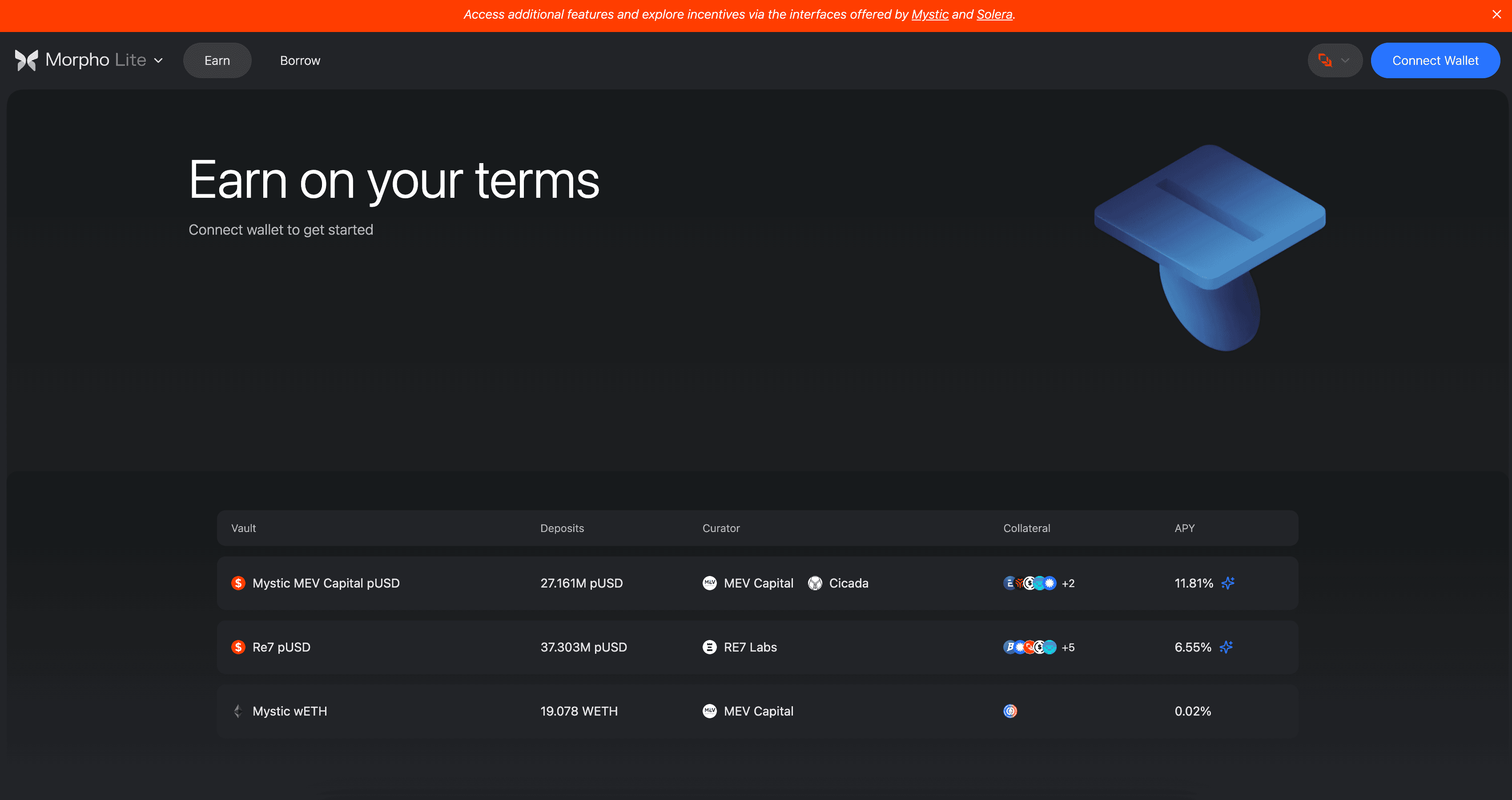
is the premier money market on Plume. It lets anyone lend and borrow assets while giving developers tools to create and curate lending markets on flexible, permissionless rails. On Plume, that translates into a straightforward money market supporting pUSD lending and RWA-backed collateral with clear risk parameters.
By the numbers:
Morpho holds ~$6.6B TVL across chains (according to DeFiLlama)
On the Earn side, you can lend pUSD into Morpho’s vaults and earn variable, often double-digit APY, driven by utilization and additional incentives.
Current Yields:
- pUSD: ~12% APY
Prefer to borrow against yield-bearing tokens? Morpho allows you to use assets like your nBASIS or nALPHA tokens as collateral to borrow pUSD. Borrow APRs are typically low relative to the yield those vault tokens earn, which makes some leverage strategies attractive.
Always keep a healthy buffer on your loan-to-value (LTV) ratio. If the value of your collateral falls or borrow-rates spike, you could get liquidated. It’s wise to borrow far less than the maximum allowed to stay safe.
Using Morpho on Plume also earns you Plume Points, adding an extra reward on top.
Mystic
is a Plume-native money market for tokenized real-world assets, which focuses on leveraging the best of RWAs to maximize their use in DeFi. Mystic is utilizing Morpho’s infrastructure – think of it as a sleek frontend with its own rewards layer. You can lend, borrow, and manage positions just like on Morpho.
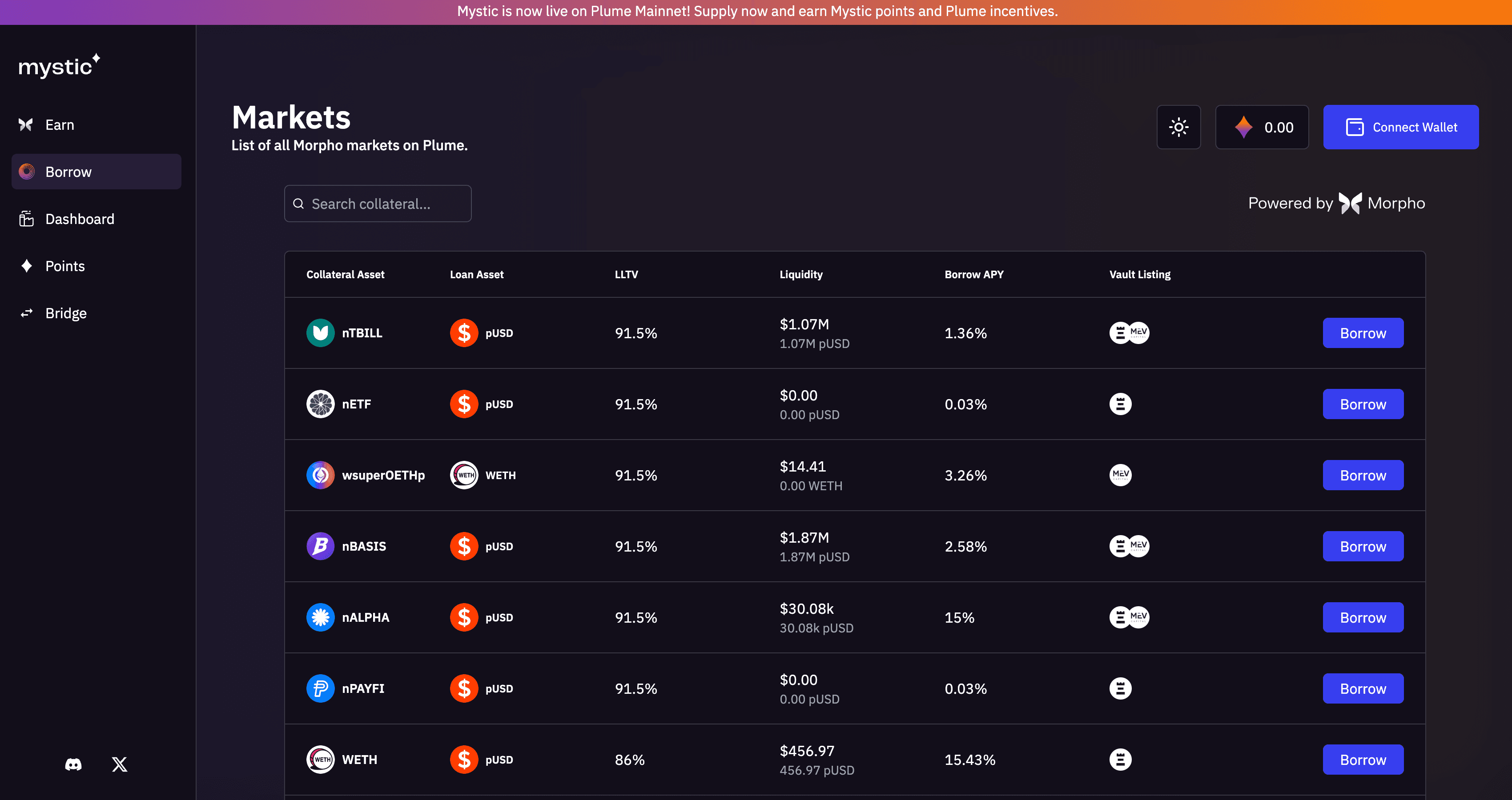
On top of the yield, Mystic rewards users with Mystic and Plume points for interacting with the protocol. That means every time you lend or borrow, you’re not only earning yield, but also accumulating points.
Current Yields:
- pUSD: ~12% APY
Looping Strategy
A popular (advanced!) strategy on Mystic is looping a yield-bearing collateral. In short, you borrow against a yield-bearing asset and reinvest the borrowed funds back into that same asset to multiply your exposure. Here’s how it works step by step:
- Deposit pUSD into Nest to mint a yield-bearing token like nBASIS (which earns ~14% APY)
- Supply nBASIS to Mystic as collateral
- Borrow pUSD against that nBASIS collateral (~2% net borrow-rate)
- Convert the borrowed pUSD back into nBASIS and deposit the new nBASIS into Mystic as additional collateral
- Repeat the borrow-and-redeposit loop until you reach your target leverage or the safe LTV limit
With the high LLTVs (Liquidation Loan-To-Value ratios) on Mystic, effective exposure can exceed 10x leverage, though most users keep far lower leverage for safety. The net yield, before fees and slippage, is the nBASIS yield on the full deposited collateral minus the pUSD borrow-rate on the full debt. For example, at 10x leverage using an ~14% APY collateral and a ~2% borrow cost, the net return could approach 120% APY on your initial capital.
Looping brings many risks! High leverage leaves little room for errors. Even small price moves, oracle changes, or borrow-rate spikes can trigger liquidations. Unwinding a looped position isn’t always simple. You may need to swap assets on a DEX to repay loans, which can incur high slippage if liquidity is low. Additionally, redeeming nTokens (like nBASIS back to pUSD) can take a few days, so you might not be able to exit instantly if things go south.
Always keep a wide buffer below the liquidation LTV, monitor your looped positions closely, and use conservative leverage. Looping is for experienced users who fully understand the mechanics and risks.
Rooster
Last but not least,
Rooster. Rooster is the official DEX for real-world assets on Plume Network. It’s built on Maverick’s “distribution-AMM” model, which lets liquidity providers fine-tune exactly where their liquidity sits on the price curve. On top of that, Rooster employs a ve(3,3) incentive flywheel to direct rewards toward the most valuable pools, aligning traders, LPs, and protocols to foster deep, efficient markets.
By the numbers:
Rooster’s TVL is currently around ~$5M (according to DeFiLlama)
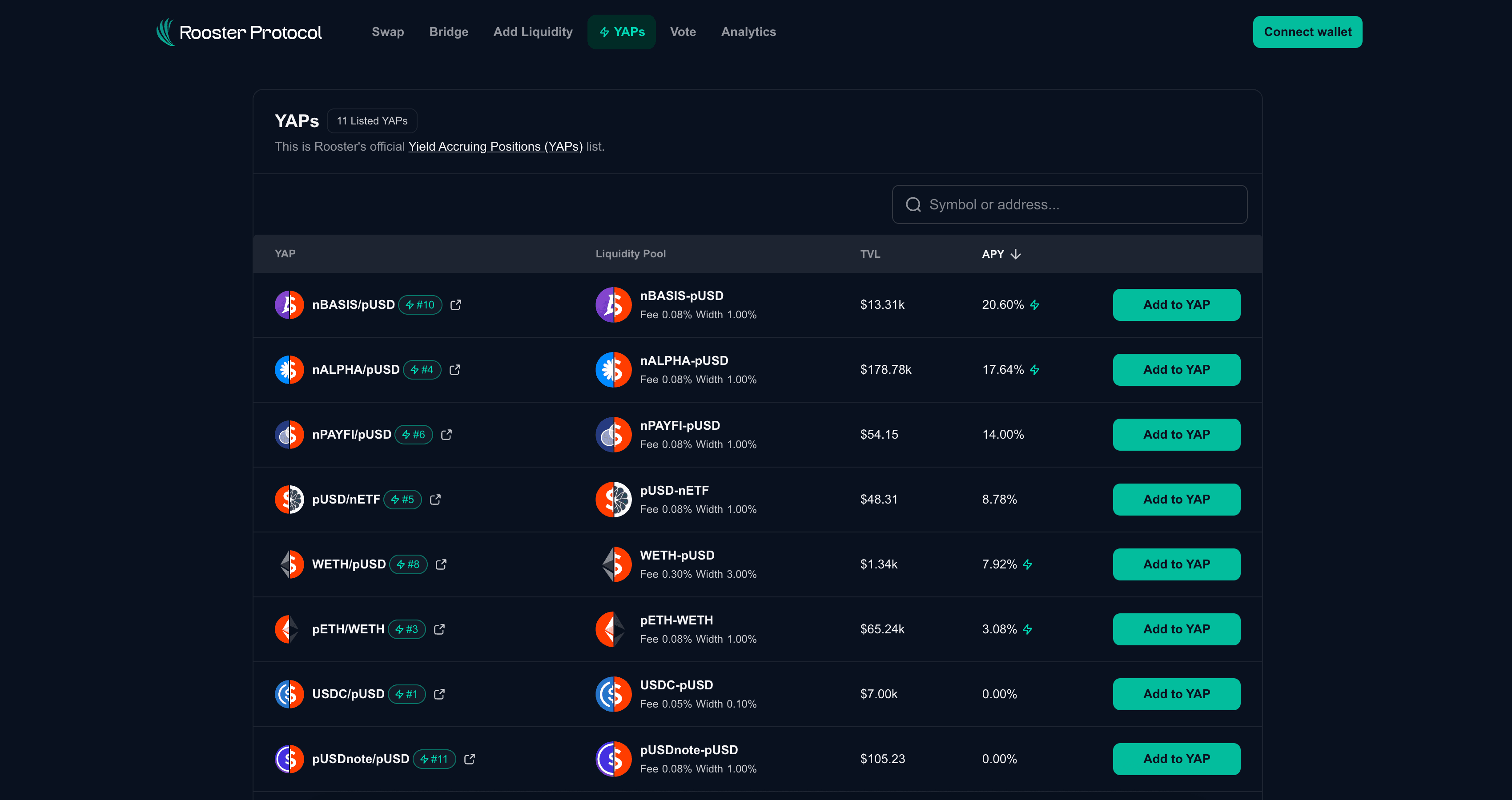
For users who don’t want to manually manage their LP ranges, Rooster offers Yield Accruing Positions (YAPs). Deposits into YAPs follow a predefined distribution shape and rewards are automatically compounded back into your position. When a user adds liquidity to a YAP, they receive a fungible token that represents the position and can be used across various DeFi protocols on Plume.
Current Yields:
- USDC/pUSD: ~50% APY
- pUSD/PLUME: ~30% APY
- nBASIS/pUSD: ~20% APY
In addition to earning swap fees, liquidity providers will soon begin receiving ROOSTER token rewards to boost yields even more.
Plume’s RWA-first DeFi ecosystem is just getting started, and it’s already delivering accessible real-yield onchain. With new integrations and products rolling out weekly, the network is quickly shaping into a hub for stablecoins, tokenized treasuries, and creative farming strategies.
Ready to jump into Plume? Start by bridging your assets to Plume via
Jumper Exchangeand explore its DeFi ecosystem today!
Disclaimer: This article is only meant for informational purposes. We encourage you to do your due diligence before using or buying tokens of any protocol mentioned. This is not financial advice.